Team Blog

Filtering by tag "Training" Clear tag

Training Topics

Quick links by selected tags
All Topics Training (7) Weekly Update (3)
2026-06-22

Extending the Aerobic Stimulus

Extending the Aerobic Stimulus

One of the most important things you can learn as a distance runner is that your run does not end the second you stop running.

Your run is not over until your post-run routine is complete.

What Does This Mean?

When you finish a run, your heart rate is still elevated and your body is still working aerobically. If you go directly into your post-run exercises, strength routine, mobility work, or stretching, you continue to develop your aerobic system while adding very little additional pounding to your legs.

This is called extending the aerobic stimulus. It allows you to gain some of the benefits of a longer training session without always needing to run extra miles.

Build Fitness

You add valuable aerobic work after the run without needing every run to be longer.

Reduce Pounding

You get more training value while limiting unnecessary stress on your legs.

Stay Healthy

Consistent post-run work helps improve strength, mobility, and durability.

The Key: Do Not Wait

To get the full benefit, you need to begin your post-run routine immediately after finishing your run.

Do not: Finish your run, sit down for 20 minutes, check your phone, hang around, and then start your exercises.

Do: Finish your run, catch your breath, and go right into your post-run routine.

Why It Matters

  • Builds your aerobic engine.
  • Adds valuable training time with minimal impact.
  • Improves strength, mobility, and durability.
  • Helps keep you healthy and injury-free.
  • Increases the effectiveness of every run.

The Big Takeaway

Your run is not over when you stop running. It is over when you finish your post-run routine.
2026-06-17

Strides

Strides: Small Effort, Big Benefits

Smooth. Fast. Relaxed. Strong.

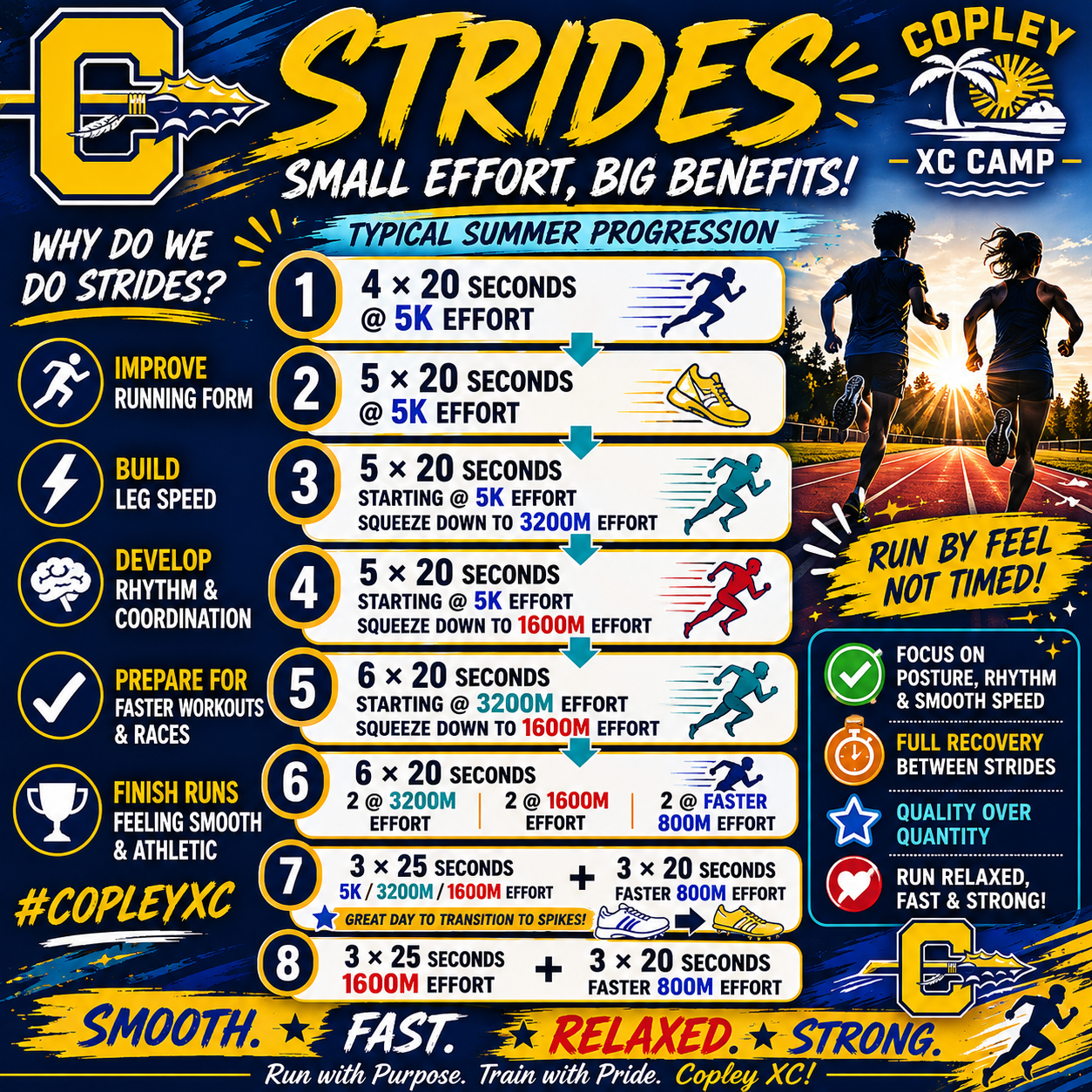
Copley XC Strides Progression Graphic

Why We Do Strides

Strides are short, controlled bursts of faster running that help athletes improve running form, build leg speed, develop rhythm, and prepare the body for faster workouts and races. The goal is not to sprint all-out, the goal is to run fast, smooth, and relaxed.

Typical Summer Progression

  • 4 × 20 seconds at 5K effort
  • 5 × 20 seconds at 5K effort
  • 5 × 20 seconds starting at 5K effort and squeezing down to 3200m effort
  • 5 × 20 seconds starting at 5K effort and squeezing down to 1600m effort
  • 6 × 20 seconds starting at 3200m effort and squeezing down to 1600m effort
  • 6 × 20 seconds — 2 at 3200m effort, 2 at 1600m effort, 2 at faster 800m effort
  • 3 × 25 seconds at 5K / 3200m / 1600m effort, then 3 × 20 seconds at faster 800m effort
  • 3 × 25 seconds at 1600m effort, then 3 × 20 seconds at solid 800m effort

Coach’s Notes

Run these by feel, don’t worry about timing every stride perfectly. Take as much recovery as needed so each rep is done with good posture, good rhythm, and smooth speed. These are also great days to transition into spikes: run the first few in trainers, change shoes, then finish the faster reps in spikes.

#CopleyXC   |   Run With Purpose   |   Train With Pride
2026-06-14

Fartlek Runs

What Is a Fartlek?

A fartlek is a run that mixes faster running with easier running. The word comes from the Swedish phrase "speed play", and that's exactly what it is: learning how to change gears while still running relaxed.

A Little History

Fartlek training was developed in the 1930s by Swedish coach Gösta Holmér. Looking for a way to help his athletes become more competitive against dominant Finnish distance runners, Holmér encouraged runners to vary their pace naturally over trails and rolling terrain. Instead of rigid track workouts with exact distances and rest periods, athletes would surge up hills, accelerate between landmarks, and recover whenever needed. The result was a training method that built both endurance and speed while keeping running fun and engaging.

See Fartlek Training in Action

Watch this quick video to see how runners use "speed play" to mix faster and easier efforts throughout a run.

Why We Use Fartleks

  • Builds endurance and speed at the same time
  • Teaches runners how to change pace during races
  • Feels less rigid than track intervals
  • Develops body awareness and pacing skills
  • Can be done on roads, trails, grass, or the track

Example Workout

20-Minute Fartlek:

Run easy for 2 minutes, then faster for 1 minute. Repeat that pattern for 20 minutes. The faster sections should feel controlled, about your 5K effort, not like an all-out sprint.

Coach's Reminder

Fartlek running is about learning rhythm. Run the faster sections with good form, stay relaxed, and use the easy sections to recover while still moving forward. Some of the best fartleks don't require a watch at all, just pick a tree, a mailbox, or the next hill and play with your pace.

Showing page 2 of 3 (7 stories).